Cell
One beat as a voltage trace, the calcium release that follows it, and how far the cell shortens and how quickly it lets go.
Human heart simulation · built on oNeura
CorScape starts from a compound's chemical structure or a disease mechanism, works out what it does to the heart's ion channels, and carries that upward through the heart cell, the tissue, the ECG and the pumping chamber. You see every step on the way, not only the answer at the end.
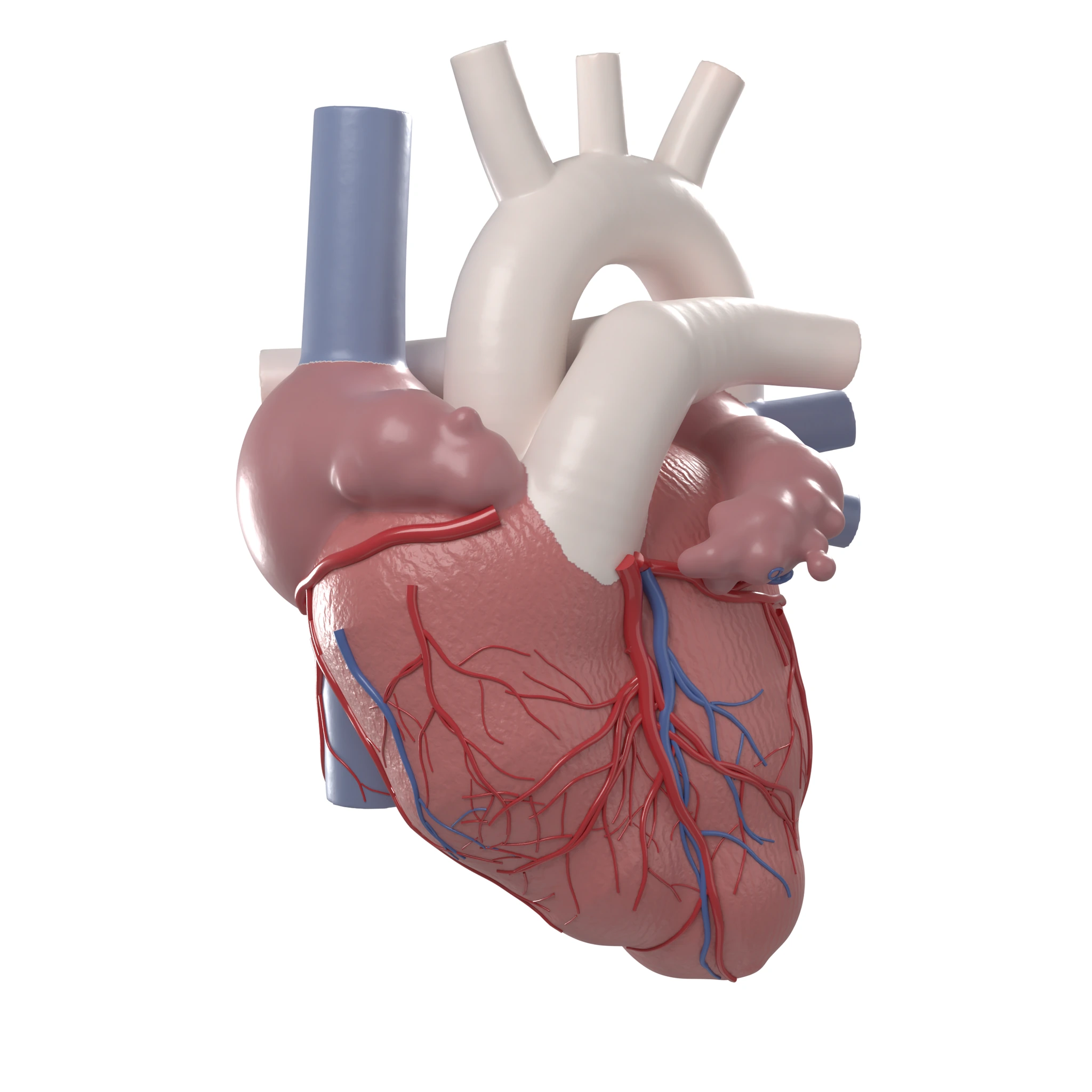
A lab test on one ion channel tells you what happens to that channel. Whether the heartbeat lengthens or the muscle squeezes less hard depends on how the channels, the calcium and the muscle fibres act on each other, beat after beat. CorScape runs them in the same model so you can watch that interaction instead of inferring it.
Capabilities
There is no fixed workflow. A safety team and a disease biologist want different things out of the same heart, so the engine is offered in pieces. Take the one piece that answers your question, or chain several so that each feeds the next.
A flat chemical structure is enough to begin, written the way chemists write SMILES. A target sequence or your own patch-clamp recordings can go in instead, or alongside it. You never have to tell us the compound's name or what programme it belongs to.
The compound is put to each of the heart's main ion channels and the model works out how much current it shuts off. A channel changes shape as it opens, closes and resets, so a compound that only blocks one of those states is treated that way rather than averaged into a single number.
In a human heart muscle cell the channel currents drive the electrical beat, the beat releases calcium, and the calcium makes the cell shorten. One model runs all three at once, so a change in any of them shows up in the other two.
Force comes from motor proteins pulling along filaments, and that is where it is modelled. A compound that changes how hard the muscle squeezes, or how slowly it lets go, acts there first and is followed from there.
The same question runs across a population of cells that differ from one another the way people do, so you see the spread of responses and the worst of them, not one average heart.
Cells are joined into a strip of muscle and the signal passes from one to the next, which is how you catch a wave slowing down or breaking up rather than one cell misbehaving on its own.
The electrical activity of all those cells adds up into a 12-lead ECG. The intervals a cardiologist reads off it come back as numbers, QRS and QTcF and J-Tpeakc among them.
The shortening cells squeeze the left ventricle, which fills and empties. Pressure plotted against volume over one beat gives the loop a cardiologist would recognise, along with the timing of each phase of the cycle.
A genetic or inflammatory cardiomyopathy goes in where it acts, in the force-generating machinery of the cell, and its consequence is followed up through the tissue to how well the chamber still pumps.
Uses
Drug discovery
A hERG number on its own rarely settles it. The same compound usually touches calcium and late sodium too, and the simulation shows whether that pulls the beat back towards normal, and what it costs you in contraction.
Channel block · heart cell · ECG
Drug discovery
Send the series as structures and compare what each one does to the beat and to contraction. The ranking arrives before tissue or telemetry money is spent, along with the one measurement most likely to overturn it.
Your structures · heart cell · virtual cohort
Disease research
Put the change where the mutation acts, in the force-generating machinery, then follow it up through the cell and the tissue to see how much pumping is lost by the time it reaches the chamber.
Disease · contraction · pumping
Disease research
Start with what inflammation does inside the heart cell, then follow that same run out to contraction, to the ECG, and to the pressure the chamber can still generate.
Disease · heart cell · ECG · pumping

A mechanism, not a score
Every scale comes back as a trace over time rather than a single score. When the heartbeat lengthens or contraction weakens, you can walk back down the scales to the current, the calcium signal or the muscle state that did it.
Electrical and mechanical results come back separately, so a longer action potential and a slower relaxation are never confused for one another.
What you get back
One beat as a voltage trace, the calcium release that follows it, and how far the cell shortens and how quickly it lets go.
A 12-lead trace, with QRS, QTcF and J-Tpeakc measured off it.
Pressure against volume for the left ventricle over one beat, and the timing of each phase of the cycle.
The inputs and the assumptions behind each result, stated in writing, so your team can check the reasoning.
Validation
In each of the five cases below, a study had already measured what the drugs do to the heart and published the answer. CorScape was given what that study started from and never what it found, so each result had to be worked out rather than looked up. Each case says what went in, what the model had to work out on its own, and how close that came to the measurements. The compounds it got wrong are named next to the ones it got right.
Against published measurements
The question was which drugs cause torsade de pointes, a failure of the heart's rhythm that can kill, and getting that call right is the hardest test in cardiac safety. A published study had already settled it for a panel of 33 drugs. CorScape was handed the ion-channel potencies for those drugs out of the literature and nothing else. The study's verdicts were withheld and nothing in the model was fitted to them, so the panel had to be sorted into risky and safe from the channel numbers alone. CorScape flagged 17 of the 23 drugs known to cause torsade and cleared 9 of the 10 known to be safe. The laboratory assay in the same paper, run on real human heart cells, reached 18 of 23 and 10 of 10. Ranking the whole panel by CorScape's own risk score rather than splitting it into calls gives an area under the curve of 0.811.
It missed six drugs. Chlorpromazine, clarithromycin, clozapine, erythromycin, moxifloxacin and procainamide all cause torsade, and CorScape cleared them. Ranolazine went wrong in the other direction and was flagged when it should have been cleared. Six configurations of the model were run and all six are reported, from 14 to 17 of 23. The whole panel reruns in about six minutes.
PMID 29311989
Against a blinded panel
In this case the compounds went into the engine with neither their names nor their outcomes attached, so there was nothing to recognise and nothing to match against. Thirteen of the fifteen had a published chemical structure and were scored. The other two cannot be simulated at all, because the source never published what they are.
Each of the thirteen had to be placed on the risky or the safe side of the line without being told which side it belonged to. Scored on the paper's own 13-variable risk instrument, at the exposure the paper treats as the reference, CorScape cleared all 5 safe compounds and flagged 5 of the 8 risky ones. It missed flecainide, terfenadine and moxifloxacin. Run across every concentration the paper tested, it caught all 8 risky compounds and cleared 3 of the 5 safe ones.
PMID 29354071
Against measured tissue
Flagging a compound as risky is only half of the decision. What settles whether it moves forward is how large the effect is, and this study measured that on human heart tissue. CorScape was set the same drugs at the same concentrations and the same heart rates, and had to produce the change in the length of the heartbeat for each one. Across 16 combinations of drug, concentration and heart rate, the simulated change in the length of the heartbeat tracks the measured change with a correlation of 0.823.
The typical error in size is a factor of 2.06. That figure moved a long way once the model worked out each compound’s grip on the hERG channel individually instead of using one shared value for all of them.
PMID 28868038
Against a published ranking
Three compounds were handed over as chemical structures and nothing else, with no potency measurements of any kind attached. A published study had already ranked the three by what they do to the heartbeat, and that ranking had to be rebuilt from the atoms and the bonds. The engine fitted its own dose-response curves to its own simulated output and put chloroquine at 0.12 µM, hydroxychloroquine at 0.36 µM, and azithromycin beyond the range the paper tested.
That is the published ordering, with the antibiotic correctly called inert. The comparison here is between the two rankings. The potency figures are fits to simulated output, not to measured data.
PMID 33483756
Against two species and a published direction
Much of the preclinical data on contraction comes from dog hearts, so the question worth asking is whether a drug does the same thing in a human one. Nine drugs that act on contraction were run through separately built human and canine heart cells, and neither model was given the other's results. Ranking the nine compounds, the two species agree on three of the four measures: 0.95 on how far the muscle shortens, 0.90 on how long it takes to relax and 0.85 on the duration of the calcium signal, each against a 0.75 threshold fixed before the run. Those three compare two of our own configurations against each other. Scored instead against the direction each source publishes for each drug, the model agrees in 10 of the 11 cases the sources allow to be scored.
The fourth measure, the size of the calcium signal, scores 0.00 and fails. The defect is open and its cause is known. The two species sit on opposite limbs of the same calcium-sensitivity curve, and the route a drug takes through that curve does not yet distinguish one species from the other. The study is recorded as not qualified while that stands.
PMID 37268094, PMID 25820236
The same engine is checked outside the heart as well. The oNeura evidence page shows how it does against recordings from single neurons, against problems whose exact mathematical answer is already known, and against measured drug interactions and mortality in clinical trials.
Pricing
from $2,500
For example: is this hERG finding a real problem?
Ask about a simulation →$10,000 per month
For example: ranking analogues as your chemists make them.
Ask about the monthly plan →from $60,000 per year
For example: a safety team running every new series through it.
Ask about a license →Tell us your question and we agree the scope and the price with you before any work starts.
Tell us the compound or the disease, what you already have, and the decision you need to make.
inquiries@blackweb.ai